
Early Signs of Dementia. What Families and Caregivers Often Notice First
For most families, the realization doesn't arrive all at once. It comes in fragments, a repeated question that feels slightly off, a missed appointment that's easy to explain away, a moment of confusion that gets chalked up to tiredness or stress.
That's exactly what makes early dementia so difficult to recognize. The signs are real, but they're subtle enough that the people closest to the situation often second-guess themselves. Is this normal aging? Am I being paranoid? Maybe it was just a bad day.
This guide is for the families navigating that uncertainty and for the caregivers who spend enough time with older adults to notice things that brief visits and doctor's appointments often miss.
------------------❤️------------------
Why Early Recognition Matters
Dementia is not reversible, but early identification creates real options. It allows families to plan ahead while the person affected can still participate in those conversations. It opens the door to medications and interventions that may slow progression. It gives everyone, the person living with dementia, their family, and their care team, more time to prepare.
Waiting until the signs are unmistakable often means waiting too long.
------------------❤️------------------
What Families Notice First
Family members tend to be the first to observe changes, precisely because they have a baseline. They know how this person has always been. Here's what often surfaces first:
✔️
Repetition that goes beyond forgetfulness. Asking the same question multiple times within a single conversation not just forgetting the answer, but forgetting the question was asked is one of the more reliable early signals. Similarly, retelling the same story word-for-word within the same visit is worth noting.
✔️
Difficulty with familiar tasks. When someone who has cooked the same recipe for forty years suddenly can't sequence the steps, or struggles to manage a bill they've always handled independently, that's different from ordinary forgetfulness. The task itself hasn't changed, the ability to organize and execute it has.
✔️ Getting lost in familiar places. Disorientation in a neighborhood they've lived in for decades, or difficulty navigating a familiar drive, tends to stand out sharply against someone's normal functioning.
✔️ Changes in judgment. Unusual financial decisions, giving large amounts of money to strangers, falling for scams, neglecting bills that were always paid on time, can reflect early changes in the brain's capacity for reasoning and risk assessment.
✔️ Withdrawal from social activities. When someone who has always been social begins declining invitations, disengaging from hobbies, or showing reduced interest in people and activities they previously enjoyed, it can be an early indicator, sometimes before memory changes are obvious.
✔️ Mood and personality shifts. Increased anxiety, suspicion, irritability, or apathy that feels out of character and unexplained by life circumstances is worth paying attention to. These shifts are often more noticeable to family than to the person experiencing them.
------------------❤️------------------
What Caregivers Notice, and Why It Matters
Professional caregivers who spend consistent time with an older adult often catch things that even close family members miss. Not because they know the person better, but because they observe from a specific vantage point: they're watching how someone functions in real daily tasks, repeatedly, over time.
At Philia, caregivers describe noticing patterns that families later recognize as early signs they had dismissed or hadn't seen at all. A few examples of what caregivers tend to observe first:
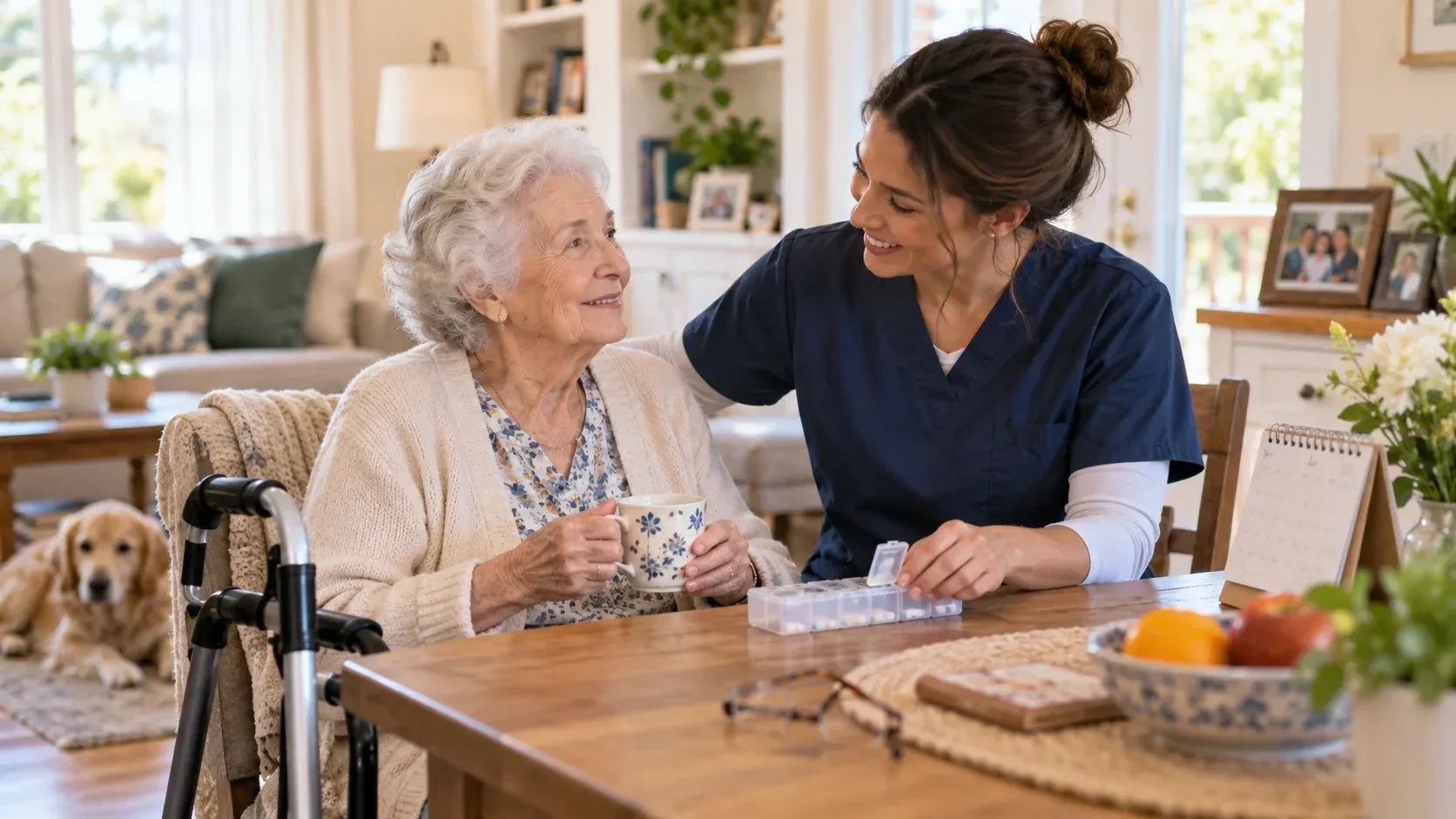
✔️ Changes in medication management. A caregiver who assists with or oversees medications will notice when a client who previously managed their own pills starts missing doses, taking double doses, or becoming confused about their regimen. This is often one of the first functional changes to emerge.
✔️ Difficulty with personal care sequencing. Bathing, dressing, and grooming involve a sequence of steps that becomes disrupted early in cognitive decline. A caregiver helping with morning routines will notice when the steps that used to flow naturally start requiring prompting or become disordered.
✔️ Changes in sleep patterns and nighttime orientation. Caregivers providing overnight or live-in support are often the first to observe sundowning, increased confusion, agitation, or disorientation in the late afternoon and evening hours, which is a common feature of early to moderate dementia.
✔️ Conversational changes. Struggling to find the right word, substituting vague terms ("that thing" or "you know what I mean") for specific nouns, or losing the thread of a conversation mid-sentence are changes that become apparent over repeated interactions.
✔️ Behavioral patterns that shift gradually. A caregiver who visits regularly develops a strong baseline for a client's normal. When that baseline shifts, in appetite, in mood, in how someone moves through their day — a good caregiver notices, even when the change is difficult to articulate.
This is one of the underappreciated values of consistent, relationship-based care. It's not just task completion — it's continuity of observation. A caregiver who has spent months building trust with a client is positioned to notice and report changes in a way that a quarterly doctor's visit simply cannot replicate.
------------------❤️------------------
What to Do If You're Noticing Signs
The first step is documentation, not diagnosis. Write down what you're observing — specific incidents, dates, and context. "Mom seemed confused" is harder to act on than "On Tuesday, Mom asked me three times within an hour whether her sister had called."
Specific, dated observations are what a physician needs to distinguish normal aging from something that warrants further evaluation. Bring them to an appointment, and ask specifically about a cognitive assessment — it's a legitimate and important request.
If the person is resistant to seeing a doctor, framing the appointment around something else (a routine check-up, a review of medications) is often more effective than a direct conversation about memory concerns, which can feel threatening and produce defensiveness.
If you are a caregiver and you're noticing changes,
communicate them to the family and, where appropriate, to the care coordinator. Observations from a caregiver carry real clinical weight. Put them in writing.
------------------❤️------------------
When In-Home Care Can Help
A diagnosis of early dementia doesn't immediately require a move to a memory care facility. Many families successfully support a loved one at home for years, with the right structure in place.
In-home care plays a specific role here: it provides the consistent presence, structured routine, and trained observation that early cognitive decline benefits from most. Caregivers who work with clients living with Alzheimer's and dementia are trained to manage the behavioral and functional changes that come with progression — providing not just physical support but cognitive engagement, safety, and companionship.
Philia serves families in Washington DC, Bethesda, and Arlington who are navigating exactly this. If you're in the early stages of understanding what your loved one needs, a care assessment is a good place to start.
While the information provided in this blog is intended to be informative and helpful, it's important to consult with a qualified professional for personalized advice. If you have any concerns or questions about your health or specific medical conditions, don't hesitate to reach out to your physician or another trusted healthcare provider. Your health is important, and seeking professional guidance ensures you receive the best care tailored to your individual needs.